
October 30, 2026
Furniture manufacturing is changing, and adhesives are becoming an increasingly important part of that shift. Modern Industrial Adhesive Manufacturers are looking beyond basic bonding strength, focusing on production speed, material compatibility, cleaner finishes, and performance under changing conditions. Furniture makers now work with wood, laminates, veneers, fabrics, foams, plastics, and composite materials, creating demand for more specialized bonding solutions. At the same time, manufacturers want adhesives that fit smoothly into high-volume production without creating unnecessary delays. In this blog, we explore the major furniture bonding trends shaping production and the technical considerations businesses should understand when selecting adhesive solutions.
Production efficiency is becoming a major consideration in furniture manufacturing. Contact adhesives can create rapid bonds between suitable surfaces, helping manufacturers move components through production without lengthy clamping or curing periods.
According to Samad Group's furniture adhesive guidance, contact adhesives can be used for upholstery, foam attachments, laminates, veneers, and decorative trims, making application speed particularly relevant to larger production lines.
Faster bonding does not eliminate preparation. Clean, dry surfaces and correct application remain essential. Uneven adhesive coverage or joining surfaces before the appropriate tack stage can affect final bond performance.
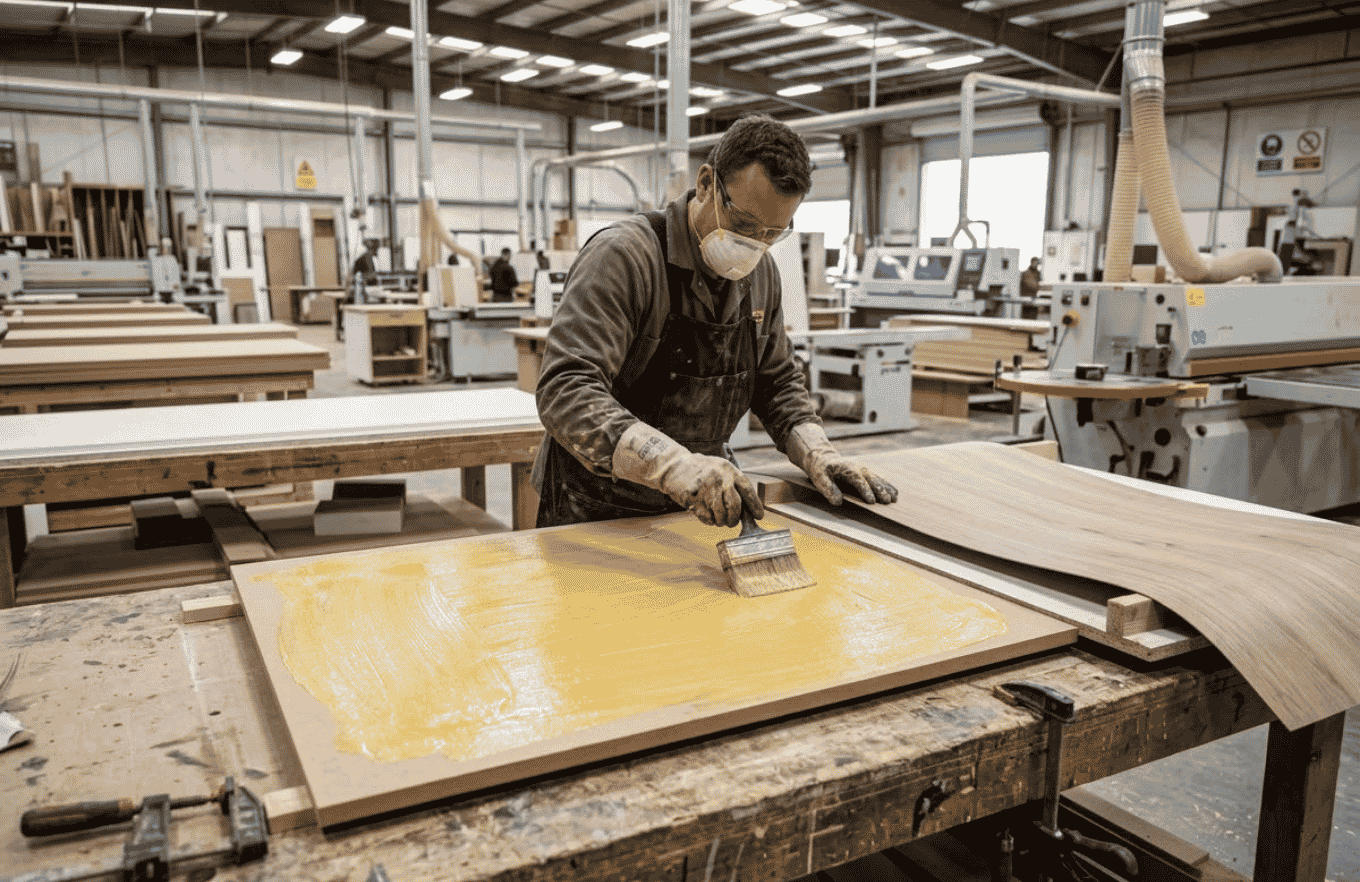
Furniture designs increasingly combine different materials, so adhesive selection cannot rely on one general-purpose formula. Wood, foam, fabric, laminate, veneer, and synthetic materials can each require different bonding characteristics.
This is why Industrial Adhesive Manufacturers are increasingly focused on application-specific formulations. The right adhesive should match the substrate, production method, environmental conditions, and required flexibility.
Moreover, furniture producers should test adhesives on their actual materials rather than assuming that a successful result on one substrate will transfer to another.
Adhesives are not only responsible for holding furniture components together. They can also influence the finished appearance. Modern furniture designs often demand smooth laminates, neat upholstery, clean edges, and minimal visible bonding marks.
Consequently, furniture manufacturers are paying greater attention to application precision and adhesive behavior. Samad Group of Industries discusses furniture bonding applications involving laminates, veneers, upholstery, and decorative elements, where a clean finish is an important part of the final product.
Polyurethane formulations have become an important part of modern adhesive technology because they can offer strong bonding with flexibility across selected applications. However, the formulation must match the intended use.
For example, PU Adhesive for Shoes is designed around footwear requirements such as sole and upper bonding rather than automatically being suitable for furniture. Profix PU Adhesive is specifically positioned for footwear and leather craft, including bonding soles made from TPR, PVC, PU, EVA, and rubber to uppers made from leather, suede, canvas, and synthetic materials.
The growing use of polyurethane technology does not mean every PU formulation should be used interchangeably. Profix PU Adhesive, for instance, includes heat resistance, plasticizer resistance, and a crystal-clear finish for its intended footwear applications. These properties demonstrate how modern formulations are engineered around specific performance requirements.

Environmental considerations are also becoming more relevant. Furniture producers are increasingly interested in formulations and production practices that can support lower emissions, efficient application, and responsible manufacturing.
Samad Group of Industries highlights sustainability initiatives involving regular testing, advanced machinery, and integrated recycling systems.
For buyers, the broader trend is clear: adhesive selection is increasingly connected to production efficiency and environmental considerations rather than bond strength alone.
The future of furniture bonding will likely center on faster application, material-specific performance, cleaner finishes, improved process control, and sustainability. Industrial Adhesive Manufacturers will continue developing solutions around increasingly complex furniture designs and production requirements.
Samad Group's adhesive history dates back to the 1960s, when Samad Rubber Works and Samad Adhesives introduced contact-based adhesive products. Its current adhesive portfolio spans applications from shoe adhesives to glue sticks.
Furniture bonding is moving toward more specialized, efficient, and application-focused solutions. Manufacturers now need to consider material compatibility, application speed, finish quality, environmental conditions, and production requirements before selecting an adhesive. Furthermore, the growing use of polyurethane technology shows why formulation-specific performance matters more than simply choosing a popular adhesive type. By understanding these trends and testing products against actual manufacturing conditions, furniture businesses can make better bonding decisions while supporting consistent production quality, efficient workflows, and the evolving expectations of modern furniture markets.
Partner with Samad Group for industrial adhesive solutions tailored to furniture, footwear, and diverse manufacturing applications with performance-focused formulations and technical expertise.
Current trends include faster bonding, material-specific formulations, cleaner finishes, improved production efficiency, and greater attention to sustainability and application control.
Not automatically. A PU Adhesive for Shoes is formulated for specific footwear substrates and conditions, so furniture applications require a product tested and specified for those materials.
Profix PU Adhesive is designed primarily for footwear and leather craft, supporting sole bonding and lasting performance across materials such as TPR, PVC, PU, EVA, rubber, leather, suede, and canvas.