
July 22, 2026
EVA Foam is widely used across industries like packaging, sports goods, footwear, yoga mats, and protective padding because of its flexibility and durability. However, one common issue manufacturers and buyers face is dimensional instability during storage. Improper handling can lead to warping, shrinkage, or surface deformation that affects final product performance.
When EVA Foam is stored correctly, it maintains its shape, resilience, and density for a much longer time. This is especially important for large-scale users such as a Yoga Mat Manufacturer, where even slight inconsistencies can impact product quality and customer satisfaction. Environmental factors like temperature, humidity, stacking pressure, and storage duration all play a role in how the material behaves over time.
Understanding proper storage methods is not just about preserving material quality; it also helps reduce waste, cost overruns, and production delays. In this article, we break down practical, industry-tested ways to store EVA Foam rolls so they remain stable and usable for long-term applications.
EVA Foam is sensitive to heat. When exposed to high temperatures, the internal structure of the foam expands slightly. Once cooled unevenly, this leads to warping or curling at the edges. Consistent room temperature storage is essential to maintain uniform structure.
Although EVA Foam is closed-cell and resistant to water, prolonged exposure to humidity can still affect surface texture and flexibility. Moist environments may not immediately damage the foam, but they slowly reduce its structural consistency over time.
Heavy stacking or uneven pressure can compress EVA Foam rolls. Once compressed for long durations, the foam may not fully regain its original thickness, leading to permanent dimensional changes.
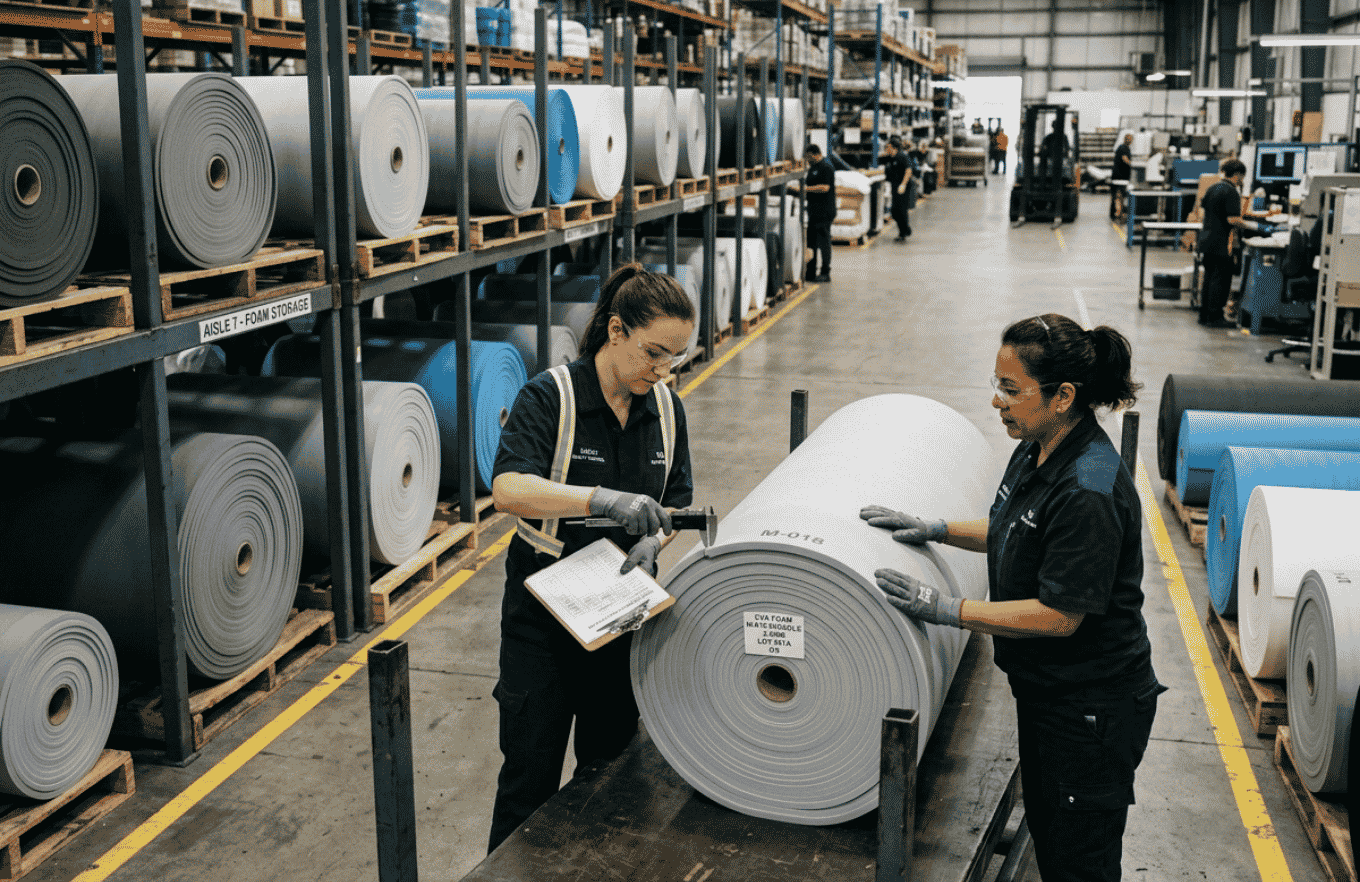
The best storage temperature for EVA Foam is between 18°C and 25°C. Avoid placing rolls near direct sunlight, heaters, or industrial machinery that generates heat. Stable temperature ensures consistent density and shape retention.
A dry storage area with proper airflow helps maintain foam integrity. Ventilation prevents moisture buildup, which can indirectly affect flexibility and handling quality.
EVA Foam rolls should always be stored horizontally on flat surfaces or racks designed to distribute weight evenly. Vertical storage can cause bending or uneven pressure over time.
Do not stack heavy materials on top of EVA Foam rolls. Even short-term pressure can lead to deformation if repeated frequently. Use shelving systems designed specifically for foam materials.
Rotation ensures that no single batch remains under prolonged storage conditions. This helps maintain consistency across production cycles, especially in industries relying on large foam volumes.
EVA Foam should not be stored near solvents, adhesives, or industrial chemicals. Even indirect exposure can weaken surface integrity and reduce performance.
Using polyethylene or stretch film helps protect EVA Foam from dust and moisture. Proper wrapping also prevents surface scratches during movement or handling.
For large foam sheets, rolling around a rigid core prevents folding lines and stress marks. This method is commonly used in export packaging to ensure long-distance stability.
Clear labeling helps track storage time and conditions. It also prevents mixing older foam batches with new ones, ensuring quality consistency across production lines.
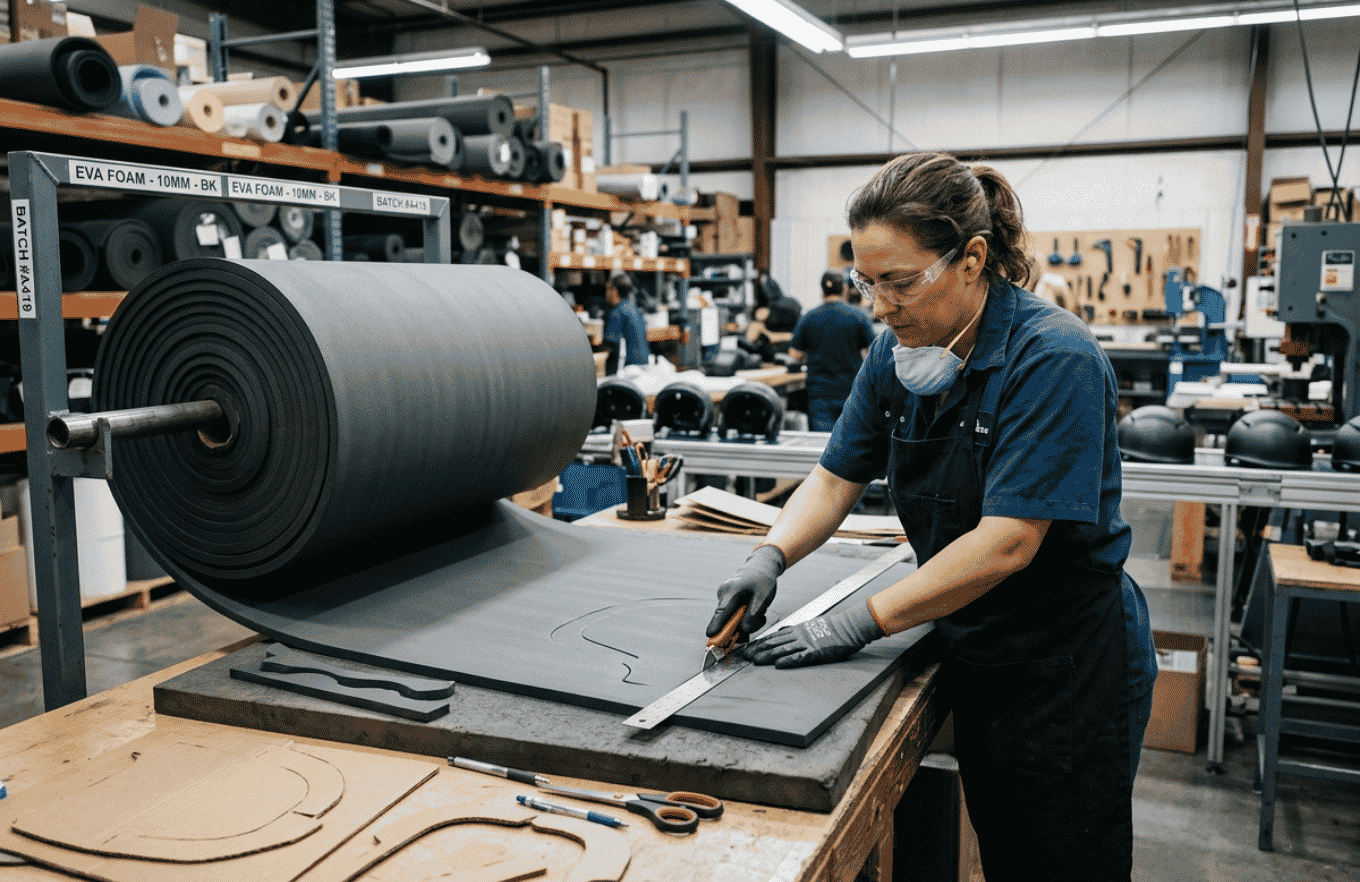
Industries like footwear, sports equipment, and protective gear manufacturing depend heavily on EVA Foam stability. Even minor dimensional shifts can affect product assembly and final output quality.
In large-scale production environments, companies such as Samad Group of Industries follow structured storage protocols to ensure EVA Foam maintains consistent performance across multiple applications. Similarly, Samad Group integrates controlled warehouse systems to minimize environmental exposure and preserve material reliability.
For yoga mat manufacturers supplying international markets, stable storage is not optional. It directly impacts product reputation, compliance standards, and operational efficiency.
One of the most frequent mistakes is storing EVA Foam in unregulated warehouse corners where temperature and humidity fluctuate throughout the day. Another issue is stacking rolls without protective separation, which increases pressure damage.
Some facilities also ignore shelf-life tracking, assuming EVA Foam does not degrade. While it is highly durable, long-term improper storage still affects performance characteristics.
Avoiding these mistakes ensures better material yield and reduces wastage in production cycles.
For manufacturers handling bulk EVA Foam inventory, implementing a structured storage system is essential. This includes climate monitoring, inventory rotation schedules, and proper racking systems.
A well-managed storage strategy improves efficiency, reduces material rejection rates, and ensures that foam quality remains consistent from storage to production line usage. Companies like Samad Group of Industries have shown that controlled logistics and warehouse discipline significantly improve long-term material performance.
Proper storage of EVA Foam rolls is critical for maintaining dimensional stability, performance, and usability. Temperature control, correct stacking, protective packaging, and regular rotation all play an important role in preventing warping and deformation.
When handled correctly, EVA Foam retains its original structure for long periods, making it reliable for industries that depend on precision and consistency. Implementing these storage practices ensures reduced waste, better product quality, and smoother production workflows.
Contact Samad Group of Industries for premium EVA Foam solutions backed by reliable storage practices, consistent quality, and performance.
EVA Foam can typically be stored for several years if kept in controlled temperature and humidity conditions without heavy compression.
The ideal storage temperature ranges between 18°C and 25°C to maintain structural stability and prevent deformation.
It is not recommended to store EVA Foam vertically for long periods, as it can cause bending and uneven pressure damage.